
Engineering showcase · Private internal project
IntelligentOS: the system we run our studio on. Proof of how we engineer.
IntelligentOS is the private system we run our own studio on. It isn't sold off the shelf or licensed, and clients don't receive a copy of it. It's here to show how we engineer AI systems: the same practices go into the separate, reusable components we build client systems from.
Since June 2026
in daily use, running the studio's own work
73
tasks finished in one week (27 Oct – 3 Nov 2026)
6
specialist roles, each with its own job and limits
44
failure scenarios tested automatically before any change goes live
The problem
Too much work, spread across too many tools.
- A studio running client services, its own software product and new ventures at the same time.
- Work was scattered across notes, task lists, code and chat. Context got lost between days, and nothing moved unless someone was at the keyboard.
- AI tools helped in bursts, but there was no shared record of what was asked, what was done and who signed it off.
Implementation
Built to be inspected, not trusted blindly.
- Runs on a private machine owned by the studio, separate from client systems and from StaffGPT.
- Every task leaves a written record of what was done and why, next to the result, so anyone can follow it later.
- Limits are settings, not code: a specialist can be paused or capped in seconds.
- Changes to the system only go live after its automated failure tests pass.
How it works
In plain terms.
Every task follows the same path. Everything is written back to one shared memory, so the next task starts with full context.
01
A task goes on the board
Each task has an owner and a clear definition of done.
02
A specialist does the work
Within its own limits, with every step recorded.
03
The work is checked
Against its definition of done, with an independent review for code.
04
A person approves
Anything public, costly or live waits for a decision.
One shared memory
Everything the system knows (projects, decisions and open tasks) is written down in one place. Nothing depends on a single chat window or on someone remembering.
A team of specialists
Instead of one assistant that tries to do everything, separate AI assistants each have one job, such as research, writing, coding or checking. Each can only touch what its job needs.
A task board with a scheduler
Work is broken into tasks, each with an owner and a clear definition of done. Ready tasks are picked up in order, within daily limits, and every attempt is recorded.
Checked before it reaches a person
Finished work is checked against its definition of done, and code gets an independent second review, before anyone is asked to approve it.
People approve what matters
Anything that spends money, goes public or changes a live system waits in one approval queue. Launches, outreach and spending stay with a person.
The dashboard
Where a person stays in charge.
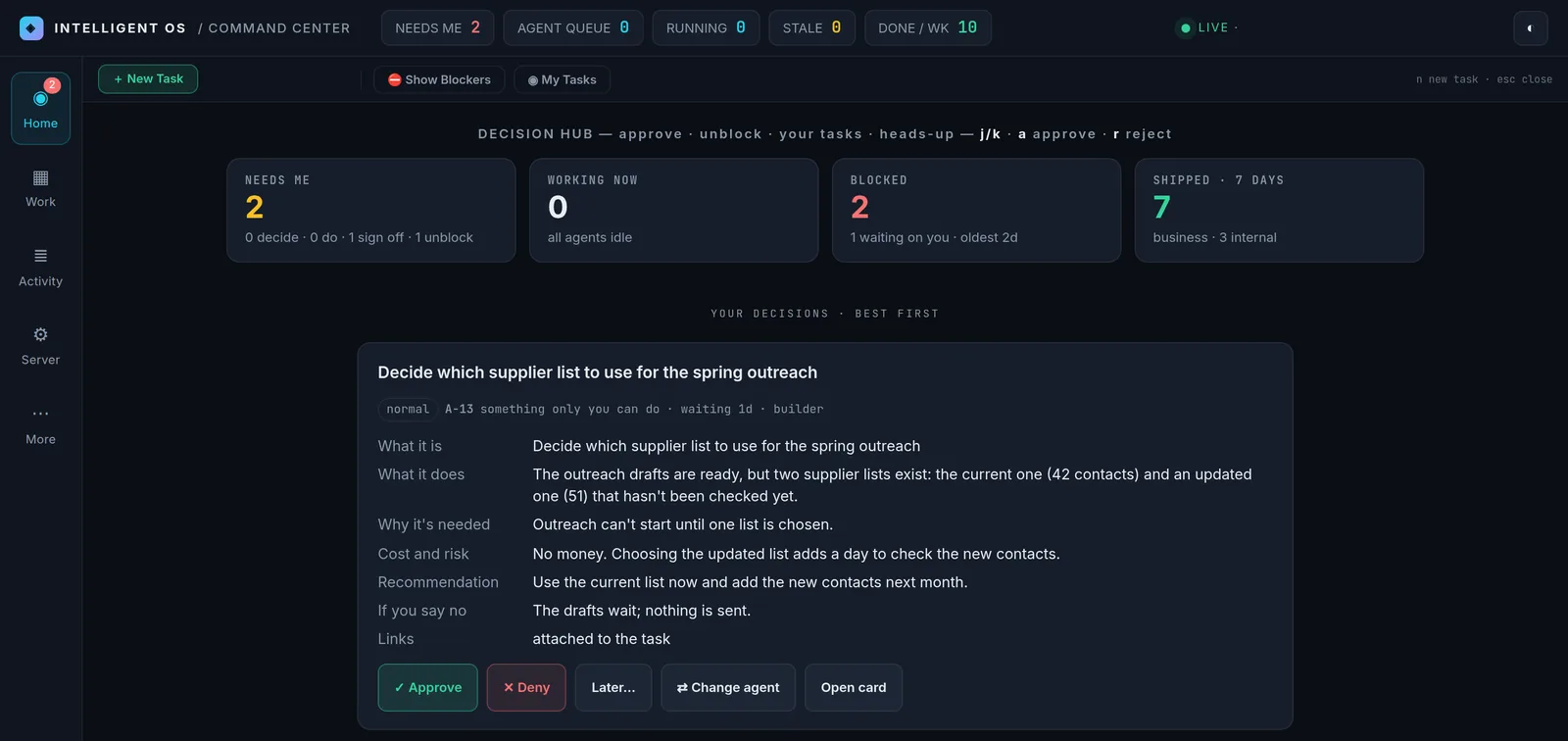
Each decision arrives as a short brief: what it is, why it matters, the cost and risk, and a recommendation. One click approves, denies or sends it back.
What carries over to client work
The engineering practices, not the system.
We don't hand over IntelligentOS as a package. What carries over are the practices it proved, built into separate reusable components and then configured around how each business works.
Practices we reuse
- A shared memory of projects and decisions
- Specialist assistants with clear jobs and limits
- A task board that schedules and records the work
- Checks and one approval queue before anything consequential
- A full written record of every task
What we configure for each business
- Which jobs the assistants take on
- The tools and data they work with
- Who approves what, and when
- Limits on cost, speed and access
- Where the system runs
Demonstration
What's shown working, and what isn't yet.
Running something and proving it works are different milestones. Each line is labelled.
- Live
Research and drafting task delivered for review
A drafting specialist researched five local restaurants and drafted a one-page site for each. The drafts arrived as a proposed change in our website code, with tests that keep them out of anything live, for a person to review.
- Live
Task board, specialists and scheduler
In daily use since June 2026; 73 tasks finished in the week to 3 Nov 2026. Reliability work continues (see lessons below).
- In development
Approval queue and restore drill
Approvals already run through one queue. A full restore from backup has not been rehearsed end to end yet, so it is not claimed.
- Live
Diagram and dashboard screenshot
Shown on this page with private details removed. The screenshot is the real dashboard filled with sample tasks.
Lessons learned
What running it taught us.
Each of these came from a real failure we reproduced and fixed. Each one is built into the systems we make for clients.
“Done” needs proof
An assistant can report a task as finished when it isn't. Completion is checked against the actual result, not the assistant's word.
Cancelled is not finished
Cancelled and completed tasks were filed in the same place, so one could pass for the other. The system now reads the recorded outcome.
A review only covers what it saw
Any change made after a review needs a fresh review, or an approval can quietly cover work nobody checked.
Safeguards must sit on the real path
A safety check only protects you if it runs every time real work starts, so ours are tested on that exact path.
Want a system like this, built around your business?
We use the same engineering practices to build a system around your tools, data and approval rules, starting with a Knowledge & Workflow OS or an Operations OS.
Prefer email? hello@codeclawstudios.com